ownyourmauihome

Maui Real Estate


Leave a comment

Consumer Confidence in Economy & Housing is Soaring

The success of the housing market is strongly tied to the consumer’s confidence in the overall economy. For that reason, we believe 2017 will be a great year for real estate. Here is just a touch of the news coverage on the subject.

HousingWire:

“Consumers’ faith in the housing market is stronger than it’s ever been before, according to a newly released survey from Fannie Mae.”

Bloomberg:

“Americans’ confidence continued to mount last week as the Bloomberg Consumer Comfort Index reached the highest point in a decade on more-upbeat assessments about the economy and buying climate.”

Yahoo Finance:

“Confidence continues to rise among America’s consumers…the latest consumer sentiment numbers from the University of Michigan showed that in March confidence rose again.”

MarketWatch:

“U.S. consumers are the most confident in the U.S. economy in 15 years, buoyed by the strongest job market since before the Great Recession. The survey of consumer confidence rose…according to the Conference Board, the private company that publishes the index. That’s the highest level since July 2001.”

Ivy Zelman, in her recent Z Report, probably best capsulized the reports:

“The results were incredibly strong and…offer one of the most positive consumer takes on housing since the recovery started.”


Leave a comment

Why Millennials Choose to Buy [INFOGRAPHIC]

Some Highlights:

  • “The majority of millennials said they consider owning a home more sensible than renting for both financial and lifestyle reasons — including control of living space, flexibility in future decisions, privacy and security, and living in a nice home.”
  • At 93%, the top reason Millennials choose to buy is to have control over their living space.
  • Many Millennials who rent a home or apartment prior to buying their own homes dream of the day that they will be able to paint the walls whatever color they’d like, or renovate an outdated part of their living space.


Leave a comment

The ‘REAL’ News about Housing Affordability

Some industry experts are claiming that the housing market may be headed for a slowdown as we proceed through 2017, based on rising home prices and a potential jump in mortgage interest rates. One of the data points they use is the Housing Affordability Index, as reported by the National Association of Realtors (NAR).

Here is how NAR defines the index:

“The Housing Affordability Index measures whether or not a typical family earns enough income to qualify for a mortgage loan on a typical home at the national level based on the most recent price and income data.”

Basically, a value of 100 means a family earning the median income earns enough to qualify for a mortgage on a median-priced home, based on the price and mortgage interest rates at the time. Anything above 100 means the family has more than enough to qualify.

The higher the index, the easier it is to afford a home.

Why the concern?

The index has been declining over the last several years as home values increased. Some are concerned that too many buyers could be priced out of the market.

But, wait a minute…

Though the index skyrocketed from 2009 through 2013, we must realize that during that time, the housing crisis left the market with an overabundance of distressed properties (foreclosures and short sales). All prices dropped dramatically and distressed properties sold at major discounts. Then, mortgage rates fell like a rock.

The market is recovering, and values are coming back nicely. That has caused the index to fall.

However, let’s remove the crisis years (shaded in gray) and look at the current index as compared to the index from 1990 – 2008:

Though prices and rates appear to be increasing, we must realize that affordability is composed of three ingredients: home prices, interest rates, and income. And, incomes are finally rising.

ATTOM Data Solutions recently released their Q1 2017 U.S. Home Affordability Index. The report explained:

“Stronger wage growth is the silver lining in this report, outpacing home price growth in more than half of the markets for the first time since Q1 2012, when median home prices were still falling nationwide. If that pattern continues, it will help turn the tide in the eroding home affordability trend.”

Bottom Line

Compared to historic norms, it is still a great time to buy from an affordability standpoint.


Leave a comment

Think You Need to Save 20% for a Down Payment? Think Again

Saving for a down payment often represents the biggest hurdle for first-time home buyers. In December, 25% of buyers on realtor.com® who were looking to purchase their first home said a key factor holding them back was lacking funds for a down payment. No matter how you cut it, it represents a big chunk of cash. But here’s the thing: It doesn’t always need to be quite so big as most think.

Many first-time buyers don’t realize that it doesn’t necessarily take 20% down to purchase a home.

Indeed, the average down payment in the U.S. on mortgages used to purchase a home was 11%, according to our analysis of loan records from Optimal Blue, an enterprise lending software company.

As with many stats, that 11% average hides lots of variation across loan types and locations. And for some buyers, it may even take more than 20% to buy a home.

Borrowers with jumbo mortgages had to put the highest percentage down, with an average of 23%. Conforming mortgages averaged 18% in 2016. On the other hand, government-backed FHA, VA, and USDA mortgages featured average down payments of 4.8%, 2.2%, and 0.4%, respectively. These government programs are meant to open up more pathways to homeownership for first-time buyers, veterans, and heads of households in rural areas.

Where you live or are thinking of living can also dramatically affect what it takes to get a mortgage. Higher-cost markets don’t just have higher-priced homes; they also have buyers with higher down payments. Lower-cost markets are just the opposite.

Higher-cost markets tend to have higher down-payment percentages because those more expensive homes are less likely to be covered by low down-payment loans.

Cutting to the chase: Without a higher down payment, the monthly payment simply ends up being too high to afford in an expensive market. Got that? This is why borrowers in high-cost areas have little choice but to put a higher percentage down on top of paying a much higher price.

That’s why, regardless of income levels, it’s so much harder for first-time buyers in high-cost areas.  And homeownership rates, especially for younger households, take a hit.

Deciphering the financial differences

Let’s dive into some specifics so that it is easier to understand the financial differences.

The average purchase price of homes financed with a mortgage was just over $290,000 in 2016 across the U.S. The average down payment amount was $32,680, or 11%.

But in the District of Columbia, where the average purchase price was just over $630,000, the average down payment was almost $110,000, or more than 17%.

That $110,000 could fund more than two-thirds of the average purchase price of $165,000 in Mississippi. And in that low-cost state, the average down payment was under $9,000, or a little more than 5%.

The variances get more extreme as we get more local.

Buyers in San Francisco County put down an average of more than $326,000 on homes purchased in 2016, which represented an average down payment of 29.9%.

In Manhattan, buyers shelled out an average down payment of (gulp) 30.2%, but because the average purchase price was slightly less than San Francisco, the dollar amount of the down payment was a more modest $219,000.

In more rural counties in the South and Midwest, average down payments can be closer to 3% and often amount to $5,000 or less. For example, in Tennessee’s Tipton County, an outer suburban county of Memphis, the average down payment was just over $3,500. The average price of a home purchased with a mortgage in 2016 was just under $138,000.

In Tipton, more than 80% of the mortgages were FHA, VA, or USDA.

So the whole etched-in-stone notion of 20% down payment or bust? Well, it all depends on how you look at it. And where.


Leave a comment

A Tale of Two Markets: Inventory Mismatch Paints a More Detailed Picture

A Tale of Two Markets: Inventory Mismatch Paints a More Detailed Picture | Keeping Current Matters

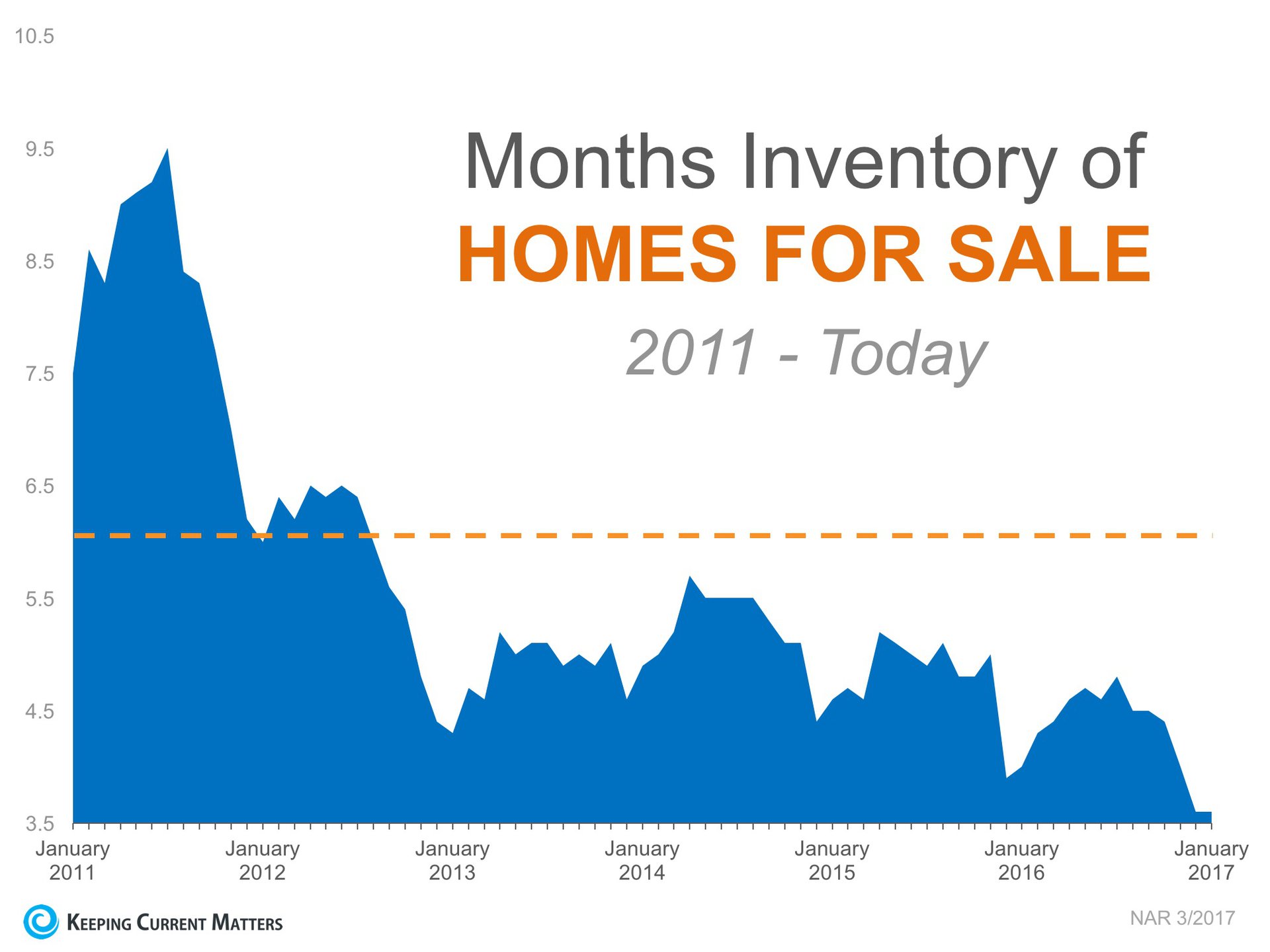
The inventory of existing homes for sale in today’s market was recently reported to be at a 3.6-month supply according to the National Association of Realtors latest Existing Home Sales Report. Inventory is now 7.1% lower than this time last year, marking the 20th consecutive month of year-over-year drops.

Historically, inventory must reach a 6-month supply for a normal market where home prices appreciate with inflation. Anything less than a 6-month supply is a sellers’ market, where the demand for houses outpaces supply and prices go up.

As you can see from the chart below, the United States has been in a sellers’ market since August 2012, but last month’s numbers reached a new low.

A Tale of Two Markets: Inventory Mismatch Paints a More Detailed Picture | Keeping Current Matters

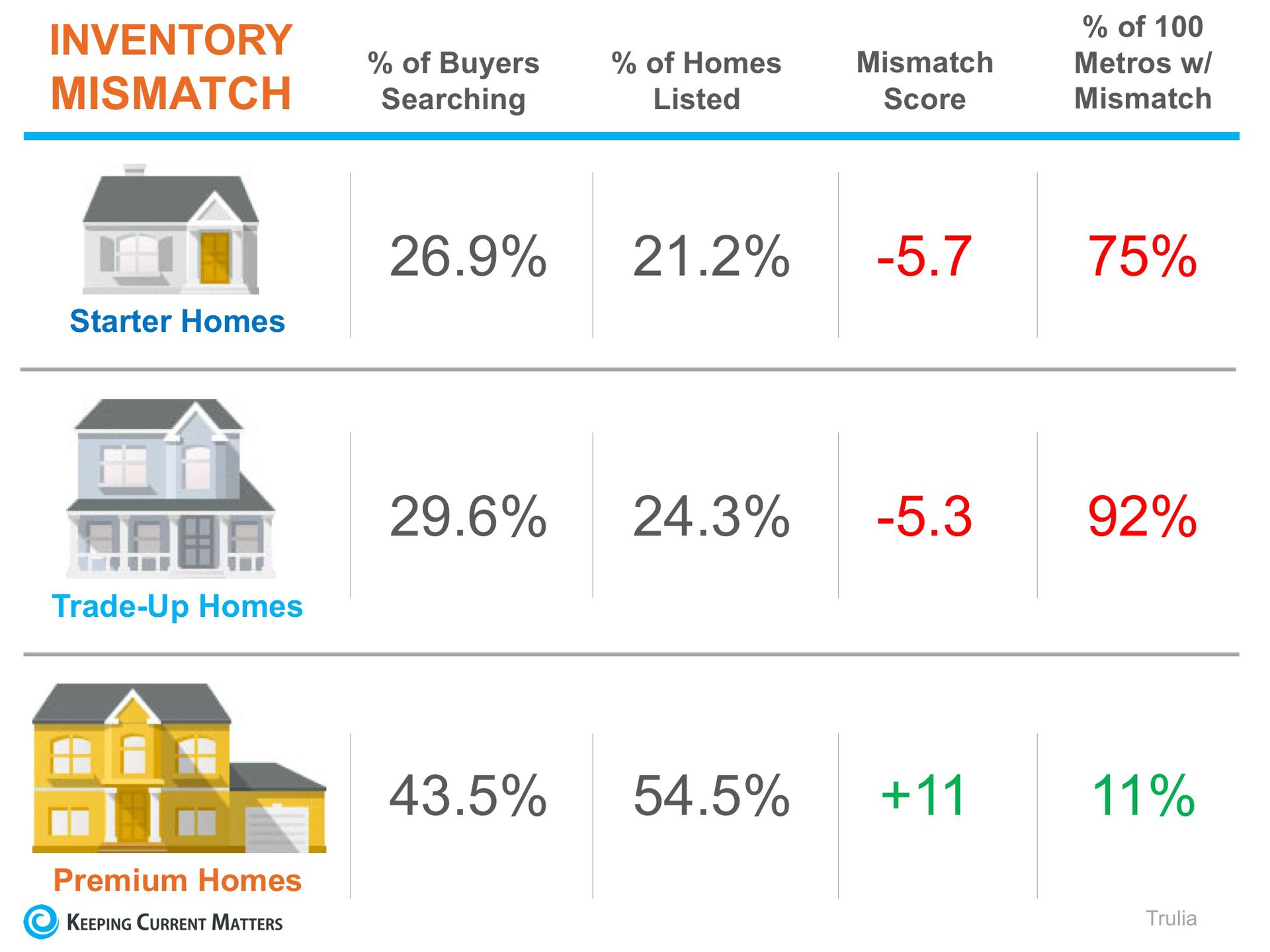
Recently Trulia revealed that not only is there a shortage of homes on the market in general, but the homes that are available for sale are not meeting the needs of the buyers that are searching.

Homes are generally bucketed into three groups by price range: starter, trade-up, and premium.

Trulia’s market mismatch score measures the search interest of buyers against the category of homes that are available on the market. For example: “if 60% of buyers are searching for starter homes but only 40% of listings are starter homes, [the] market mismatch score for starter homes would be 20.”

The results of their latest analysis are detailed in the chart below.

A Tale of Two Markets: Inventory Mismatch Paints a More Detailed Picture | Keeping Current Matters

Nationally, buyers are searching for starter and trade-up homes and are coming up short with the listings available, leading to a highly competitive seller’s market in these categories. Ninety-two of the top 100 metros have a shortage in trade-up inventory.

Premium homebuyers have the best chance of less competition and a surplus of listings in their price range with an 11-point surplus, leading to more of a buyer’s market.

“It leaves Americans who are in the market for a home increasingly chasing too fewer options in lower price ranges, and sellers of premium homes more likely to be left waiting longer for a buyer.”

 Lawrence Yun, NAR’s Chief Economist doesn’t see an end to this coming any time soon: 

“Competition is likely to heat up even more heading into the spring for house hunters looking for homes in the lower- and mid-market price range.”

Bottom Line

Real estate is local. If you are thinking about buying OR selling this spring, sit with a local real estate professional who can share with you the exact market conditions in your area.


Leave a comment

The Misleading Math Behind the Rent vs. Buy Calculation

There’s about $13.1 trillion stashed away in the United States, in plain sight. Where? In our homes!

Do we have your attention yet?

That’s the total value of the equity held by over 75 million U.S. homeowners, according to the latest estimates from the Federal Reserve Board. And that works out to almost $175,000 per owning household.

This is unmistakable evidence that homeownership is a critical building block of household wealth. Owning a home is a key reason why the median net worth of a homeowner is almost $200,000 while the median net worth of a renting household is just over $5,000.

Sure, part of that is because owners were able to pony up a chunk of money to put down on a house, and to qualify for a mortgage. But the act of paying for a mortgage actually helps produce more wealth, by freezing payment amounts and building equity through forced savings.

rent-vs-own

A 30-year amortized, fixed-rate mortgage is a beautiful thing. It provides an affordable path to buying a home while locking in today’s cost of that home for the life of the loan.

The traditional rent versus buy argument compares the total monthly costs of buying a home with a mortgage with the corresponding rent. So that comparison is relevant when it comes to representing  the housing choice trade-off in clear cost terms.

Two years ago, that head-to-head heavily favored buying, thanks to very low mortgage rates and lower prices. Back then, more than three-quarters of the counties in the country saw lower buying costs than renting costs.

With prices and rates higher now, less than half of the counties in the country see math that favors buying.

But those raw numbers hide the fact that unlike a rent check, a percentage of every monthly mortgage payment—after the lender is paid interest—goes toward the owner’s home equity. That means it’s really a forced savings plan.

Over time, less of the mortgage payments go toward interest and more go toward equity, so the savings power is enhanced further.

Here’s how that works out for a median-price home of $250,000 bought in January with 20% down with a monthly payment of $976.

Before their first payment, the proud new homeowners had $50,000 in equity thanks to their down payment. (Actually, 20% down isn’t always typical or necessary, but, hey, it keeps this illustration simple.)

640x434

In the first year, an average of 29% of the monthly payments builds equity. After 12 payments, the homeowners have just over $3,400 in added equity.

By year 14, 50% of the monthly $976 payment goes toward equity. Don’t forget that the monthly payment hasn’t changed, because the interest rate was fixed.

At the end of the 14th year, just shy of $64,000 has been added to the initial $50,000 in equity.

In the final year of the 30-year mortgage, while the monthly payment remains $976, 98% of the monthly payments builds equity until that magic day when the home is owned free and clear.

Think you can beat that with rents? Researchers at Harvard put it this way:

“While studies simulating the financial returns to owning and renting find that renting is often more likely to be beneficial, in practice renters rarely accumulate any wealth. In no small part this seems traceable to the difficulties households face in trying to save absent either a clear goal or an automatic savings mechanism.”

So, you want a better rent versus buy illustration? First, find a place to rent for no more than $976—the same as our mortgage payment example above. If you can rent for less, great. Will you be able to save that difference amounting to at least $3,400 in the first year? That would imply you can really pay only about $700 in rent to get the same savings effect.

If you can’t save $3,400 yourself by paying less in rent, ask the landlord if he’ll take a portion of your rent payments and set it aside for your rainy day fund.

Then ask the landlord if he’ll set your rent payment at today’s rate for the next 30 years. And before you close the deal, ask him to raise the rainy day share each year by 1% to 2% until year 30, when he’ll get only 2% of the rent payment.

Clearly, this would not be easy to do.

Even if the house only keeps pace with inflation over 30 years, which is a very conservative assumption, the forced savings inherent in a mortgage guarantees a homeowner is building wealth. A renter household has to be extremely diligent to amass the same savings that the good ol’ 30-year mortgage does automatically.


Leave a comment

Do You Know the Real Cost of Renting vs. Buying? [INFOGRAPHIC]

rent-vs-buy-kcm

Some Highlights:

  • Historically, the choice between renting or buying a home has been a close decision.
  • Looking at the percentage of income needed to rent a median-priced home today (30%), vs. the percentage needed to buy a median-priced home (15%), the choice becomes obvious.
  • Every market is different. Before you renew your lease again, find out if you could use your housing costs to own a home of your own!

Overall and practicality wise, owning a home is so much better than renting out. If ever you have decided in buying your own home this year, feel free to email me. Let me help you find the perfect home for you!


Leave a comment

Buyer Demand Is Outpacing the Supply of Homes for Sale

The price of any item is determined by the supply of that item, as well as the market demand. The National Association of REALTORS (NAR) surveys “over 50,000 real estate practitioners about their expectations for home sales, prices and market conditions” for their monthly REALTORS Confidence Index.

Their latest edition sheds some light on the relationship between Seller Traffic (supply) and Buyer Traffic (demand).

Buyer Demand

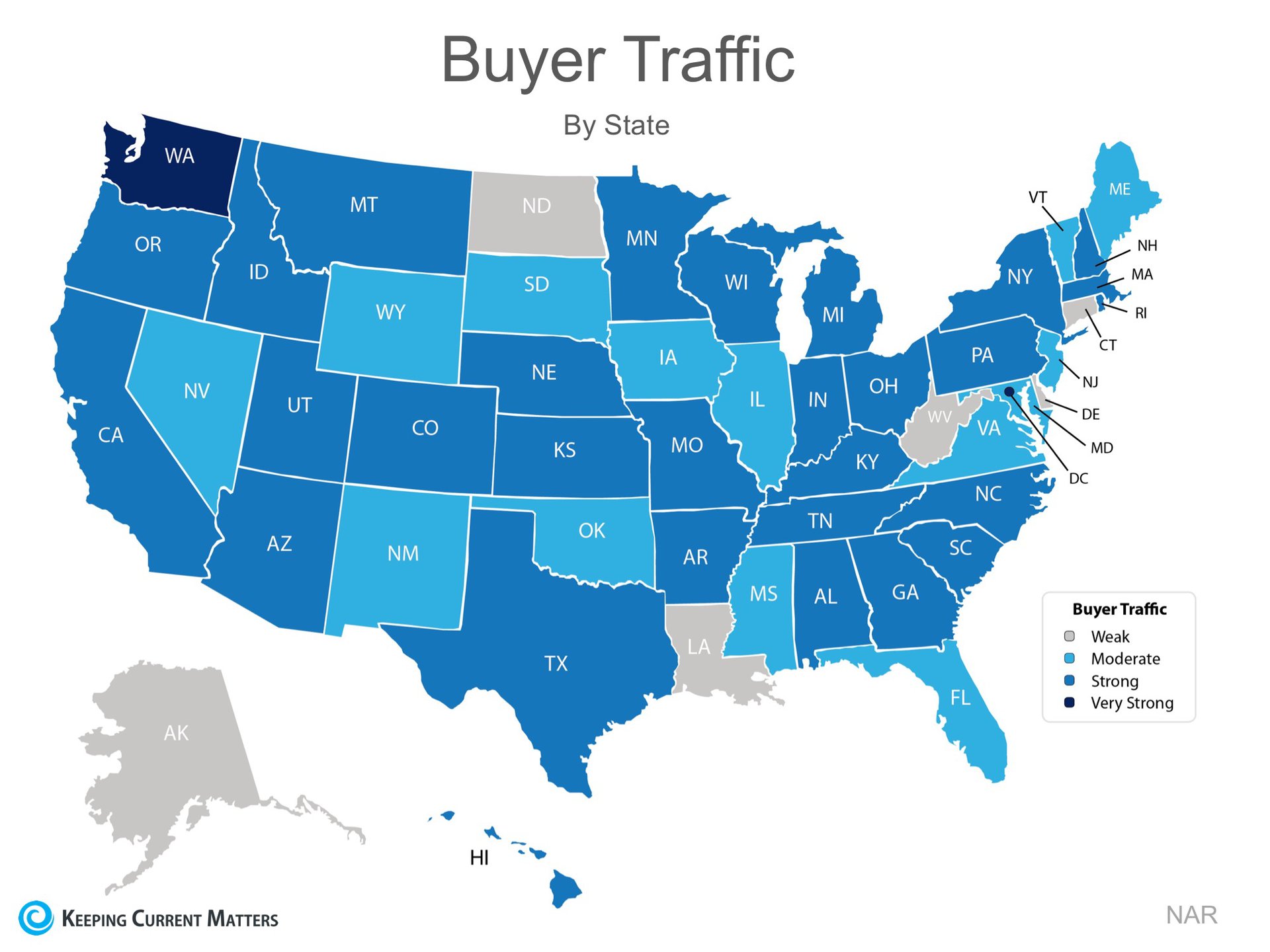
The map below was created after asking the question: “How would you rate buyer traffic in your area?”

Buyer Demand Is Outpacing the Supply of Homes for Sale | Keeping Current Matters

The darker the blue, the stronger the demand for homes in that area. Only six states had a weak demand level.

Seller Supply

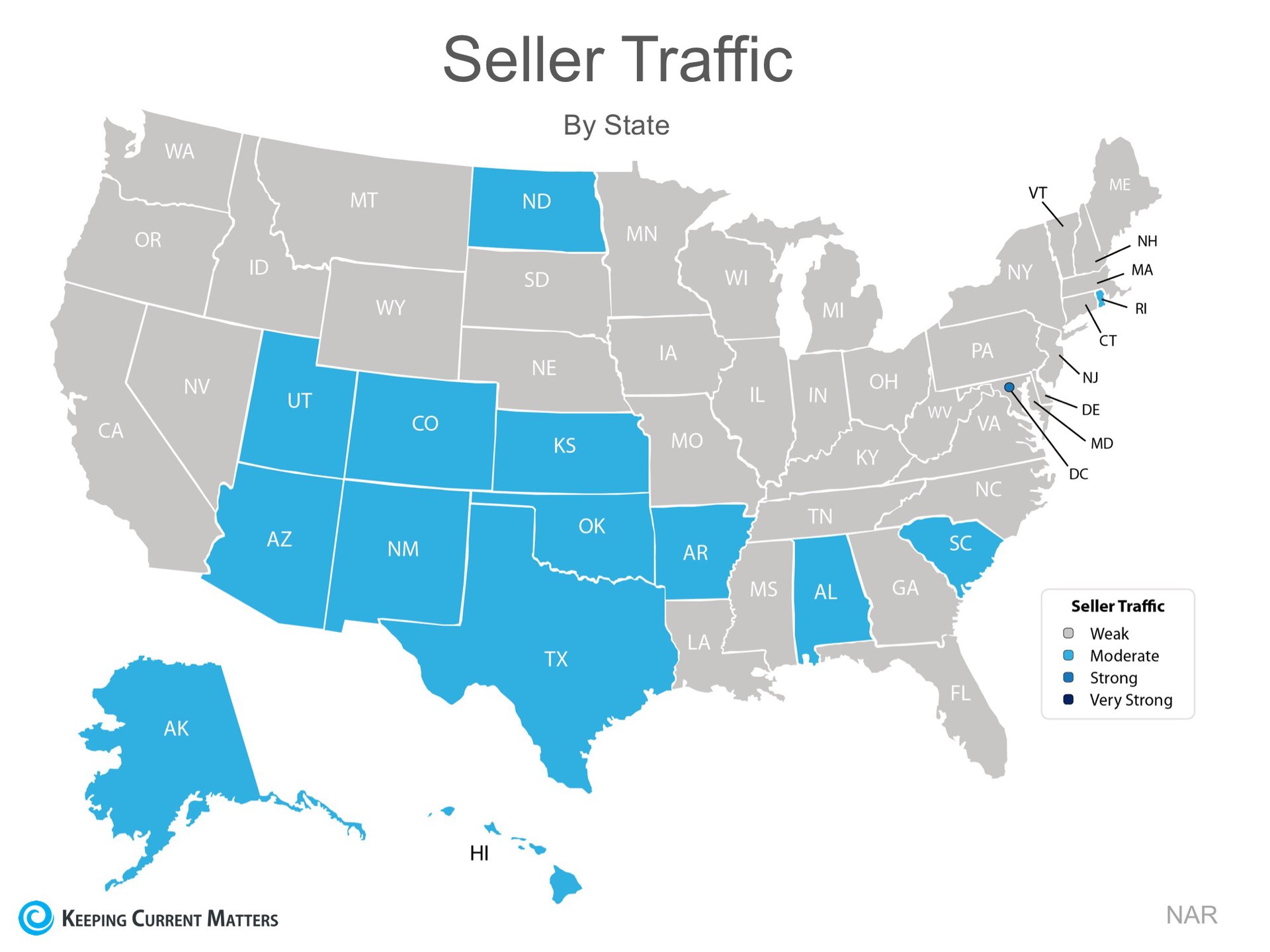
The Index also asked: “How would you rate seller traffic in your area?”

As you can see from the map below, the majority of the country has weak Seller Traffic, meaning there are far fewer homes on the market than what is needed to satisfy the buyers who are out looking for their dream homes.

Buyer Demand Is Outpacing the Supply of Homes for Sale | Keeping Current Matters

Bottom Line

Looking at the maps above, it is not hard to see why prices are appreciating in many areas of the country. Until the supply of homes for sale starts to meet the buyer demand, prices will continue to increase. If you are debating listing your home for sale, shoot me an email and let me help you meet buyer demands by listing your home today.


Leave a comment

Stuck on You: 6 New Wallpaper Trends That Will Make You Say ‘Wow’

Just like Joan Jett, wallpaper has a bad reputation. For many, the word conjures up visions of garish florals covering every possible square inch of an otherwise adorable home.

And removing it? Well, that’s a whole other horror show. If you’ve ever had the unfortunate task of scraping off reams of tacky wallpaper from your parents’ kitchen, you probably walked away with one main thought: Never again.

But today’s wallpaper ain’t like your mama’s wallpaper. Wallpaper is making a big comeback, and it’s better than ever. Seriously.

“Wallpaper is back in the spotlight,” says Cassie Crooke, the studio manager at Rumor Designs in Steamboat Springs, CO. “Wallpaper scarred homeowners in the past, with outdated patterns and adhesives making the entire experience cumbersome and dreaded.”

But modern wallpaper is easier to remove—and easier to apply. (Some simply peel off the wall, making those miserable hours seem like a cruel joke.) What’s more? Modern wallpaper designs are bold, fun, funky, and graphic. Begone, itty-bitty flowers and pink borders. Adieu, fat stripes that made your childhood bedroom look like a circus.

From city skylines to innovative embellishments with beading and tile, wallpaper is no longer outdated—it’s design’s next frontier. Here are some of the trends to watch:

1. Metallic wallpaper

Eclectic Bathroom

We’ve gilded our teacups and dotted our bookshelves with bronze objets d’art—why not add a little gleam to our walls?

“We’ve seen a trend in metallics shining through simple patterns and textures,” Crooke says. Whether they’re integrated into complicated stripes or geometry or used to add depth and interest to an eclectic pattern, expect modern wallpapers to boast an Art Deco–inspired pop of glamour.

Just be careful if you go the DIY route: Matching complicated patterns might require a pro, because the metallic shine emphasizes any irregularities. Perfect edges are hard enough without a material that makes it glaringly obvious where you’ve screwed up.

———

2. Silk wallpaper

Contemporary Dining Room

Silk wallpaper might seem like the kind of luxury you simply can’t justify. But just consider how amazing it can look paired with dramatic art and streamlined furniture. And then treat yo’ self.

Created by applying silk threads to a paper backing, this elegant, neutral wallpaper “creates a light, elegant texture,” says Warren Sheets, an interior designer in San Francisco. That makes the effect ideal for dining rooms and bedrooms—but maybe skip the kitchen.

“This style is very delicate and not for high-use areas,” Sheets says.

———

3. Embossed wallpaper

Davenport Ranch - Westlake

Embossed wallpaper is a new take on texture, allowing homeowners with tighter budgets to mimic classic plaster work designs such as the fleur-de-lis or acanthus leaves. If you can swing it (a roll can easily cost hundreds of dollars), you’ll feel immersed in luxury.

Most patterns require painting afterward to bring out the raised, textured effect. With careful brushstrokes and a steady hand, your entire wall might appear plucked from a 19th-century French country estate. Or aim for modern drama by painting the entire assembly in a rich, vivid jewel tone.

———

4. Embellished wallpaper

Hollywood Regency Powder Room

Manufacturers are increasingly adding ornamentation to their designs, Sheets says. Today’s wallpaper features beading, recycled tile, and glass to give your walls an upscale, mosaic-like effect. It’s the perfect way to create a luxurious space that’s (admittedly) just a bit over the top. But is drama in decor ever really a bad thing?

Three-dimensional embellishments aren’t the only luxury upgrade designers are adding to today’s wallpaper. Hand-painted accents bring dimension and class to a small space. Just prep your wallet beforehand: Embellished wallpapers can be tremendously expensive, making them good choices for accent walls and small spaces.

———

5. Geometric wallpaper

The Art Apartment

Cool, right? Geometric wallpaper is having a moment right now. And with such a wide variety of fun, timeless designs (cubes, herringbone patterns, or blocky and bold) available, we don’t expect this trend to disappear any time soon.

Brave homeowners can cover a whole room in these funky geometric patterns, but if you’re worried the effect might be too busy, consider an accent wall. Choose a dark background with a light (or metallic!) design, and pair it with a simple wood console for a high-impact statement wall.

———

6. Digital print wallpaper

Powder Room

Modern technology means wallpaper is no longer limited to simple, repeating patterns.

“The evolution of digital printing has enabled wallpaper designers to go in wild new directions,” Sheets says. Instead of opting for a small-scale trellis pattern, you can turn your bathroom into a veritable garden. Plaster your wall with colorful insects or a sky full of shooting stars.

Nature isn’t your only large-scale wallpaper option. Consider watercolor, or simply get your favorite image printed.

Whether or not you have plans of selling your home, you should always make sure to invest in its appearance. You bought yourself a house because it looked great when it was staged. Don’t let that be the end of it. What it will look like will depend on you.


Leave a comment

Staging VS Decorating: What’s The Difference?

Selling your home means selling a lifestyle, but not necessarily your own. In home staging, you’re striving for a look that is fresh and welcoming yet not really taste specific. People with varying tastes need to feel that they can make the home their own if they purchase it.

This is the distinction between decorating your home and staging it to sell. It can be hard to understand at first, but if you don’t know the difference, you might not sell your house as quickly as you like.

Although everyone has different tastes in decor and furnishings, most people want a home that is welcoming, functional, peaceful and organized. Tailor your house so that buyers will describe it in those terms rather than by your style of decorating. Getting rid of clutter and having fewer but larger accessories is a great place to start.

Making sure your home isn’t taste specific doesn’t mean your rooms should be devoid of color. Instead, keep color schemes simple and dose them with an on-trend neutral, like a clean tan, a soft gray or a warm white.

contemporary-living-room

If you have a distinctive decorating style — whether it’s Tuscan, shabby chic or modern — you’re going to need to scale it back a bit. If you don’t, your home will appeal to the small percentage of potential buyers who love your chosen style. Staging is about strategic editing and depersonalizing, rather than decorating and personalizing.

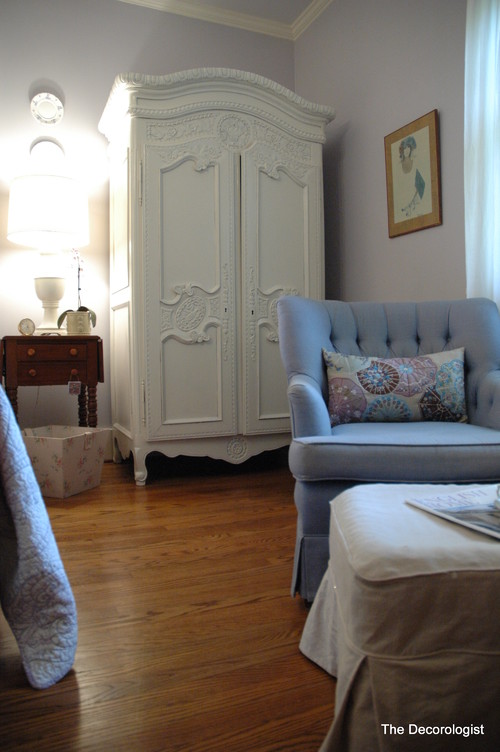
Gustavian Bedroom

Dated is dreary. Strive to stage your space with a current and fresh feel. Use updated neutrals on the walls and furnishings that are clean-lined and simple. Punches of color are great; just use them sparingly. A room arranged symmetrically and centered on the architecture reads as peaceful — one of those important aesthetics every buyer is drawn to.

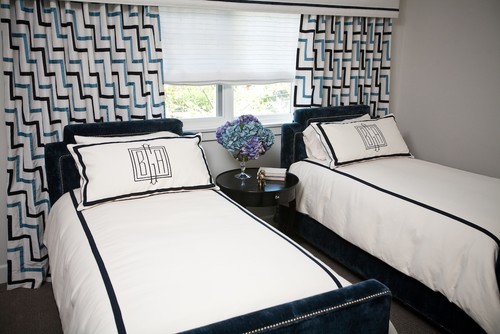
Bauman Photographers

This guest bedroom is full of great staging ideas. It has lots of on-trend design details, but it’s sparse on accessories and other distractions. The color palette is simple, easy on the eyes and would be attractive to both men and women. Most potential buyers would remember this appealing room long after leaving the house.

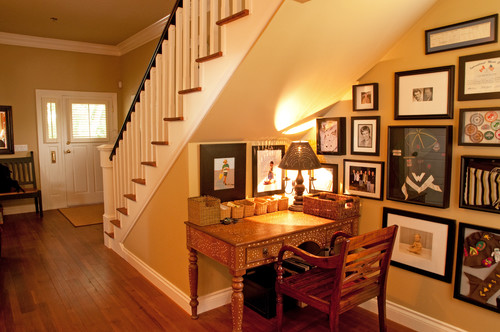
Interior Repaint by Warline Painting

This clever arrangement draws attention to the unique architecture in the space and illustrates a smart use for the area under the stairs: an office nook. This area is nicely decorated, not staged.

If I were staging this area, I would keep the desk, chair and lamp, remove overly personal items such as family photos, and leave a few pieces of art and an attractive notebook and pen. Simple accessories can help draw attention to a functional space.

If you are updating a kitchen or bath before putting your home on the market, keep the finishes neutral and classic. This is not the time to show off your personal style. You want to broaden your buying audience by appealing to a wide variety of tastes and preferences. This bathroom would definitely appeal to buyers with either traditional or contemporary taste, and could later be personalized with the new homeowner’s preferences for color and accessories.

Refined Rustic Master Bath Remodel: Ambler, PA

Sure, this may not be what normally sits on your countertop, but doesn’t it look better than the usual bills and coupons? Remember, you are selling an idealized lifestyle, not your reality.

The bottom line is that you have to get outside your head and inside the mind of a potential home buyer. It’s very difficult to be objective about your own home, but it’s crucial if you want to sell it.

Cottage and Vine
Make your home stand out with classic yet catchy interior design that’s sure to captivate even the sharpest eyes. Keep yourself updated with this blog for more home improvement tips!
Create your own website, free on WordPress.com.Create your own website.
Start free